Dense settlement and irrigated agriculture along the two rivers.
Iraq Overview
REPUBLIC OF IRAQ جمهورية العراق
Iraq — Land of two rivers.
Ancient cities, an oil-powered economy, and a landscape shaped by the Tigris and Euphrates. Explore the forces that have made Iraq—and those shaping its future.
COUNTRY OVERVIEW · SEPTEMBER 2026
Statistics carry their own reference dates.
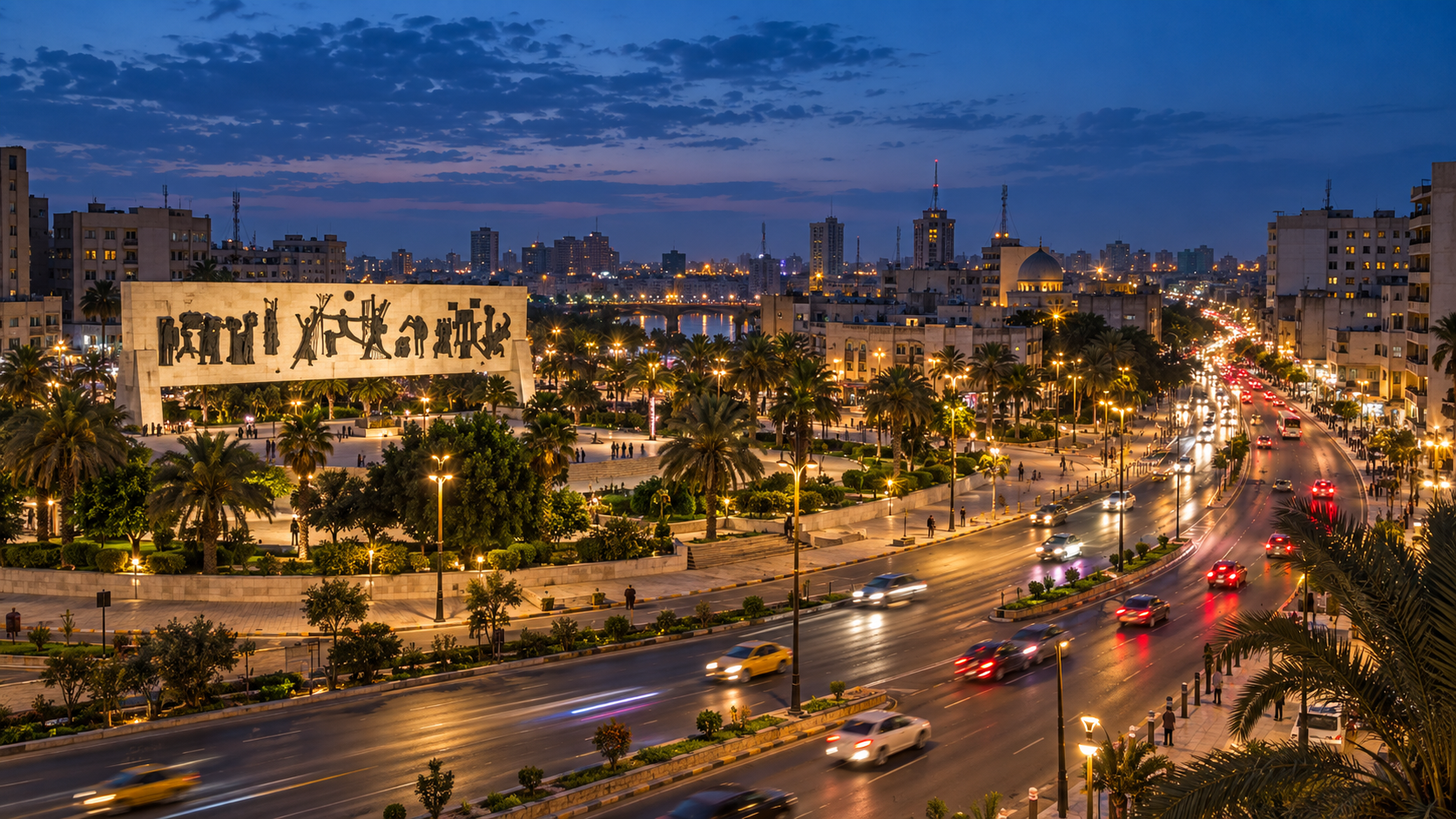
CAPITAL
Baghdad
On the Tigris River
OFFICIAL LANGUAGES
Arabic & Kurdish
Recognized in the constitution
CURRENCY
Iraqi dinar
International code: IQD
LAND NEIGHBORS
6 countries
A crossroads of Western Asia
Geography
Mountains, desert, rivers, and marshland.
A country organized around water
Iraq sits between the Arabian Peninsula, the Levant, Turkey, and Iran. Turkey lies to the north; Iran to the east; Kuwait and Saudi Arabia to the south; and Jordan and Syria to the west. A short Gulf coastline gives a large inland country its maritime outlet.
The Tigris and Euphrates sustain the central and southern alluvial plain. They meet to form the Shatt al-Arab, which flows past the Basra area toward the Gulf. These waterways connect settlement, farming, industry, and trade.
Read: Iraq National Investment Commission · geographic overview
NORTH & NORTHEAST
Mountain country
Zagros foothills and highlands, cooler uplands, and rain-fed farming.
CENTER & SOUTH
The river plain
WEST & SOUTHWEST
Desert plateau
Arid open country, sparse settlement, and long overland routes.
FAR SOUTH
The Ahwar marshes
Wetland habitats and communities whose livelihoods depend on freshwater.
History
Ancient Mesopotamia is part of Iraq’s heritage; the modern state has a distinct history.
c. 3500–2000 BCE
The first cities
CENTER & SOUTH
The river plain
Dense settlement and irrigated agriculture along the two rivers.
NORTH & NORTHEAST
Mountain country
Zagros foothills and highlands, cooler uplands, and rain-fed farming.
CENTER & SOUTH
The river plain
Dense settlement and irrigated agriculture along the two rivers.
NORTH & NORTHEAST
Mountain country
Zagros foothills and highlands, cooler uplands, and rain-fed farming.
CENTER & SOUTH
The river plain
Dense settlement and irrigated agriculture along the two rivers.
NORTH & NORTHEAST
Mountain country
Zagros foothills and highlands, cooler uplands, and rain-fed farming.
CENTER & SOUTH
The river plain
Dense settlement and irrigated agriculture along the two rivers.
Finance & economy
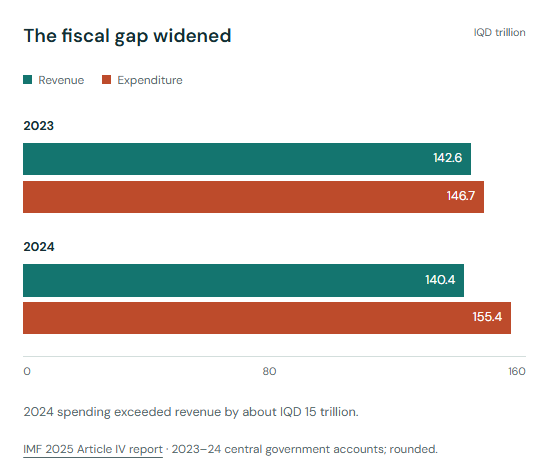
Oil income reaches the wider economy through the state.
Revenue is concentrated. Needs are broad.
Public salaries, pensions, services, and investment connect oil receipts to household spending and business activity. When oil income falls, financing these commitments becomes harder.
The Iraqi dinar is issued by the Central Bank of Iraq. Banking modernization, digital payments, stronger oversight, and access to business credit are important parts of economic reform. A larger private sector would broaden employment and reduce reliance on government hiring.
Budget revenue and GDP measure different things: revenue is money received by the government; GDP measures economic output. The chart compares government receipts and spending, not the size of the whole economy.
Oil & energy
A global resource base. A domestic diversification challenge.145 billion barrels
Proved crude oil reserves in 2023, as reported in the EIA’s 2025 country analysis. Reserves are estimated recoverable resources—not annual production. Large southern fields such as Rumaila and West Qurna underpin the industry; northern fields and export infrastructure also matter. Production depends on investment, field conditions, OPEC+ policy, and access to export routes. Oil wealth does not automatically deliver reliable electricity. Gas capture, power generation, and grid investment are separate priorities. Export disruption can reduce revenue even when international prices rise.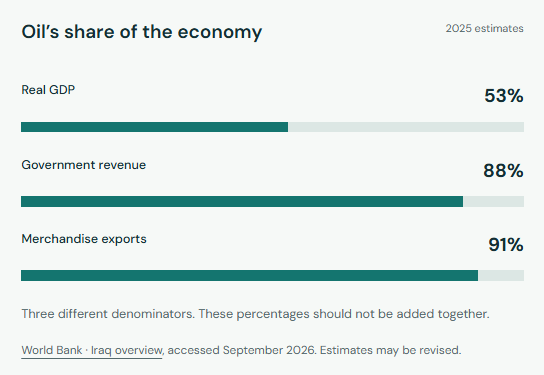
2026 context
The World Bank reports that regional conflict and disruption through the Strait of Hormuz have constrained oil exports and production. This makes trade routes and fiscal resilience especially important. This page is a dated overview, not a live market feed.
Agriculture
Food production depends on where—and when—water is available.
From grain fields to date palms
Wheat and barley are major winter cereals. Northern rain-fed areas depend heavily on seasonal rainfall, while central and southern farms rely more on irrigation. Dates, vegetables, rice, and other crops diversify production where conditions permit.
Drought, heat, soil salinity, drainage problems, and reduced river flows limit productivity. Irrigation improvements and better water management must work together; expanding cultivation alone cannot resolve water scarcity.
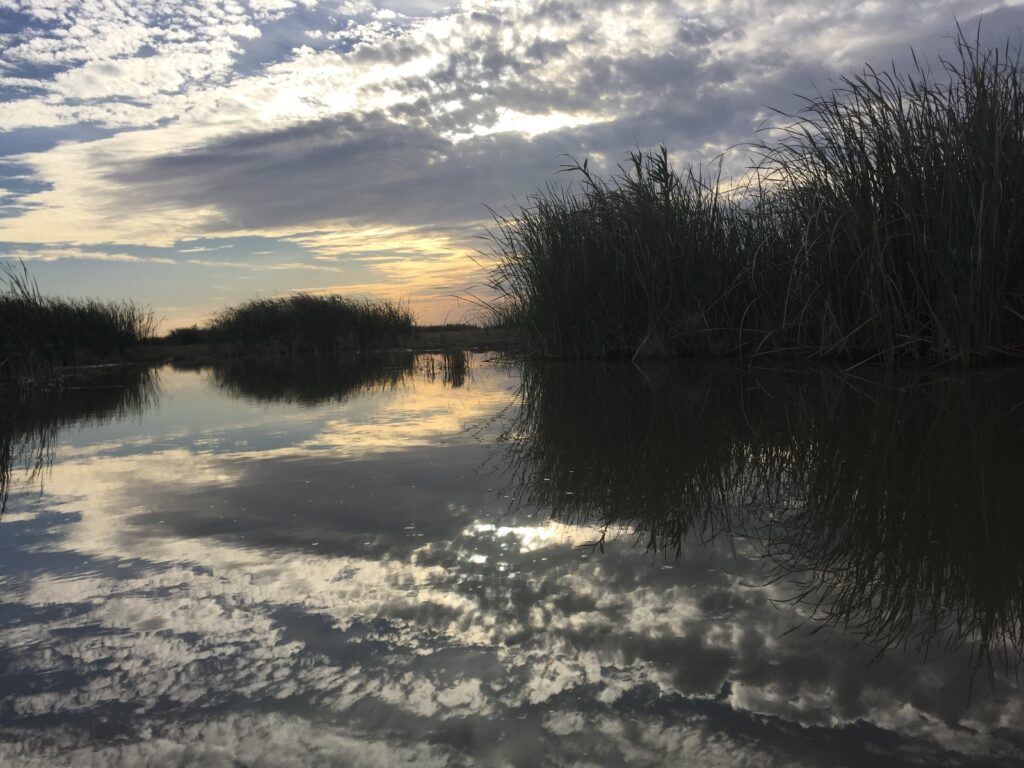
Farming also supports rural work, food processing, and trade. In the southern marshes, fishing, buffalo husbandry, and reed-based livelihoods tie the local economy to wetland health.
Sources: FAO · agriculture sector background · FAO GIEWS · current crop assessments · UNESCO · the Ahwar
Weather & climate
Hot, dry summers; cooler winters with most of the rain.
One country, different climate zones
Much of Iraq has an arid climate. Summer heat is particularly intense in the lowlands; the northern mountains are cooler and wetter, with winter snow at higher elevations. Baghdad’s conditions should not be treated as representative of every region.
Rainfall is concentrated in the cooler part of the year. Summer dryness increases irrigation demand, while dust storms can affect air quality and transport. Long-term warming adds pressure to water supplies, crops, and electricity demand.
World Bank Climate Change Knowledge Portal · 1991–2020 climatology.
DEC–FEB
Winter
Cooler conditions; rain in the lowlands and possible snow in the mountains.
MAR–MAY
Spring
Rapid warming; variable rainfall and episodes of airborne dust.
JUN–AUG
Summer
Very hot and mostly dry in the plains; strong cooling and irrigation demand.
SEP–NOV
Autumn
Heat gradually eases; rainfall returns unevenly later in the season.
Seasonal guide, not a forecast. Baghdad weather and climate information ↗
Politics & government
A federal parliamentary republic with a diverse political landscape.
Federal institutions
The 2005 constitution establishes a federal, democratic parliamentary republic. The Council of Representatives legislates and oversees government. The president is head of state; the prime minister leads the government, subject to parliamentary confidence.
Regions & representation
The Kurdistan Region has constitutionally recognized autonomy. Relations with Baghdad involve budgets, resource management, and the division of authority. Iraq’s population includes Arabs, Kurds, Turkmen, Assyrians and other communities, with diverse religious traditions.
Political priorities
Coalition building, public services, corruption, jobs, and control of armed groups are recurring issues. Relations with Iran, Turkey, Arab neighbors, and the United States intersect with Iraq’s domestic politics and sovereignty.
Recent transition
Parliamentary elections were held in November 2025. Parliament elected Nizar Amedi president on 11 April 2026. Government formation and coalition alignments should be read against dated reporting, rather than assumed unchanged. Presidential election record ↗
Transportation
Connecting inland cities to the Gulf and neighboring markets.
01 / ROAD
The everyday network
Roads connect major cities, border crossings, and local markets. Congestion, maintenance, road safety, and last-mile links influence passenger travel and freight costs.
02 / RAIL & PORTS
A north–south corridor
Umm Qasr is a key maritime gateway. A World Bank railway project approved in June 2025 aims to improve the route between Umm Qasr and Mosul. The US$930 million financing is an investment commitment, not a completed railway.
03 / AIR
International connections
Baghdad, Basra, Erbil, Sulaymaniyah, and Najaf provide important airport gateways for business, family connections, and religious travel. Available routes and operating conditions change; this overview is not a timetable.

Simplified corridor diagram, not a route map. World Bank · railway extension and modernization project.
Read further
Primary sources, historical references, and transparent data dates.
This overview combines long-term context with dated statistics. The finance chart uses 2023–24 accounts published by the IMF in 2025; oil shares are World Bank estimates for 2025; oil reserves refer to 2023. Climate text describes seasonal patterns, not today’s weather. Sources accessed 10 September 2026.