
Iraq’s Energy Sector Enters a New Investment Phase
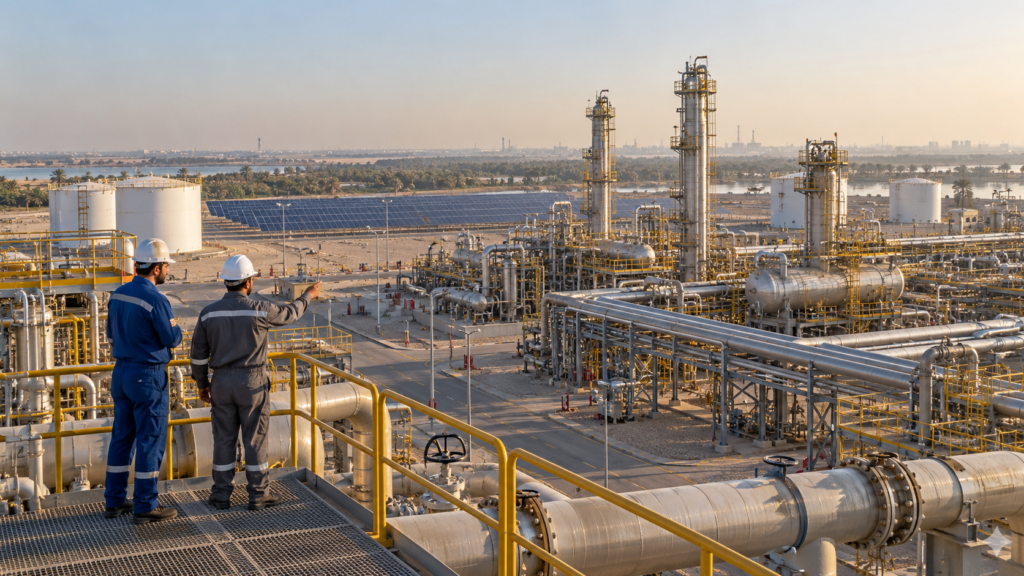
Iraq’s energy sector is entering a new phase shaped by major international investment, improved use of domestic resources, and growing efforts to strengthen electricity production. Oil remains the foundation of the country’s economy, but current projects increasingly connect oil production with natural gas recovery, renewable energy, water management, and local economic development.
This broader approach could create opportunities not only for major energy companies, but also for Iraqi contractors, equipment suppliers, engineering firms, logistics providers, and skilled workers.
A Broader Energy Strategy
For decades, Iraq’s energy industry has been dominated by crude-oil production and exports. Although the country possesses significant natural-gas resources, large quantities of associated gas produced alongside oil have traditionally been burned through flaring.
At the same time, Iraq has relied partly on imported gas and electricity to meet domestic demand. This combination—wasting locally produced gas while importing energy—has created both an economic challenge and an opportunity for investment.
The current direction is to capture more associated gas, process it inside Iraq, and supply it to domestic power stations. If executed successfully, this can reduce waste, improve electricity generation, lower dependence on imports, and create additional industrial activity.
Renewable energy is also becoming part of the strategy. Solar power cannot replace oil and gas in the near term, but it can diversify electricity generation and help meet rapidly growing demand.
The Gas Growth Integrated Project
One of the most important developments is the Gas Growth Integrated Project, or GGIP, led by TotalEnergies in partnership with Basrah Oil Company and QatarEnergy. The project represents an investment of approximately $10 billion and combines four major components: natural-gas recovery, oil-field development, solar electricity, and seawater treatment.
The project plans to recover gas currently flared at southern oil fields and process it for use in Iraqi power stations. Its main gas-processing facility is designed to support approximately 1.5 gigawatts of electricity-generation capacity.
The GGIP also includes the redevelopment of the Ratawi oil field. Production is planned to increase in stages, eventually reaching approximately 210,000 barrels per day.
Construction has also begun on a one-gigawatt solar-power facility in the Basra region. According to TotalEnergies, the plant is expected to supply electricity equivalent to the needs of around 350,000 homes when fully operational.
Another component is the Common Seawater Supply Project. The facility will treat seawater and transport it to major southern oil fields, where it will be used to maintain reservoir pressure. Replacing freshwater with treated seawater for this industrial purpose could preserve valuable river and groundwater resources for agriculture and local communities.
New Opportunities for Iraqi Businesses
Projects of this size generate demand far beyond drilling and oil production. Opportunities may emerge in civil construction, mechanical and electrical installation, transportation, maintenance, inspection, environmental services, security, accommodation, catering, and workforce training.
Local companies that meet international standards for safety, quality control, documentation, and financial transparency will be better positioned to participate in contracts and subcontracting opportunities.
The project’s developers have placed particular emphasis on Iraqi employment and local contracting. TotalEnergies has stated that Iraqi workers are expected to fill more than 85 percent of the direct jobs created by the GGIP. Thousands of Iraqi workers are expected to participate during peak construction.
For local firms, however, participation will require preparation. International operators commonly demand documented safety procedures, trained personnel, reliable financial records, suitable insurance, and the ability to deliver work according to strict technical schedules.
Challenges Remain
Iraq’s energy opportunity is significant, but progress will depend on consistent project execution. Investors continue to consider regulatory clarity, payment reliability, contracting procedures, infrastructure limitations, and political stability when assessing the market.
Electricity transmission and distribution also require continued investment. Increasing generation capacity will not fully resolve shortages unless the national grid can efficiently deliver electricity to homes, businesses, and industrial facilities.
Environmental performance will also receive greater attention. Reducing gas flaring, managing industrial water responsibly, and controlling emissions are becoming increasingly important to international investors and financial institutions.
Market Outlook
Iraq’s energy sector is gradually moving from a model focused mainly on crude-oil production toward a more integrated system combining oil, gas, electricity, solar energy, and water infrastructure.
The expansion of cooperation between Iraq and international energy companies indicates continued interest in the country’s resource base. In September 2026, Iraq and France announced that Iraq and TotalEnergies had agreed to begin discussions concerning additional energy projects, potentially opening the door to further investment.
The most important test will be implementation. Projects must move from agreements and announcements to functioning facilities, reliable electricity, local employment, and measurable economic benefits.
For businesses watching the Iraqi market, the emerging opportunity is larger than oil alone. Companies capable of supporting energy infrastructure, meeting international operating standards, and developing strong Iraqi partnerships may find an expanding range of opportunities as this new investment phase develops.
Sources: TotalEnergies – Gas Growth Integrated Project · TotalEnergies – Construction of the GGIP’s Final Major Projects · Reuters – Iraq and TotalEnergies Discuss Additional Energy Projects