
Iraq’s Digital-Payment Transformation
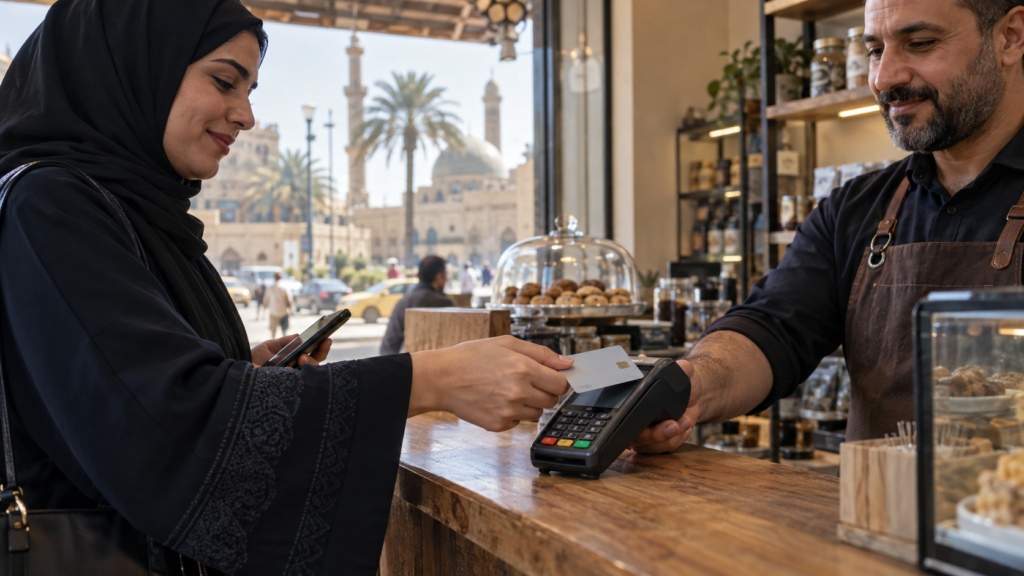
Iraq has traditionally operated as a cash-based economy. Salaries, retail purchases, government fees, and commercial transactions have frequently depended on physical currency, even as digital-payment systems expanded rapidly across neighboring markets.
That environment is now beginning to change. Government policy, Central Bank regulations, salary localization, payment cards, electronic wallets, and point-of-sale terminals are gradually moving more Iraqi transactions into the formal financial system.
The transition remains incomplete, but it represents one of the most important changes taking place in Iraq’s consumer and banking markets.
From Cash Toward Electronic Payments
Cash remains deeply established in everyday Iraqi commerce. Many consumers continue to prefer physical currency because it is familiar, widely accepted, and independent of internet connectivity or banking systems. Some businesses also remain reluctant to accept electronic payments because of transaction fees, settlement concerns, or limited technical knowledge.
However, the disadvantages of a heavily cash-based economy are substantial. Cash transactions are more difficult to document, create additional security and handling costs, and reduce financial transparency. Businesses operating mainly in cash also have fewer opportunities to establish the financial records needed to obtain credit or attract formal investment.
Electronic payments can address some of these problems by creating verifiable transaction histories, reducing dependence on physical currency, and making payments more efficient for consumers, businesses, and government institutions.
Regulation and Government Support
A major step came with Iraq’s Digital Payment Regulation No. 2 of 2024, which established an updated regulatory framework for electronic-payment services.
The regulation strengthened the Central Bank of Iraq’s supervisory role and introduced requirements covering licensing, transaction records, consumer protection, and the responsibilities of payment-service providers. The framework is intended to support a safer and more organized payment market as the number of electronic transactions grows.
Government institutions have also encouraged the installation of point-of-sale terminals and electronic collection systems. These measures allow citizens to pay certain fees and service charges electronically rather than relying entirely on cash.
The localization of government salaries has played another important role. When salaries are deposited into bank accounts and accessed through payment cards, employees gain a direct connection to the formal banking system. This can introduce customers to additional services such as transfers, electronic purchases, savings products, and personal financing.
Expanding Payment Options
Iraqi consumers today have access to a growing range of digital-payment methods, including bank cards, prepaid cards, mobile applications, electronic wallets, payment terminals, and online-transfer services.
Retailers, restaurants, fuel stations, pharmacies, hotels, and government offices are increasingly installing point-of-sale terminals. Adoption remains uneven, particularly outside major cities, but electronic payment is becoming more visible in Baghdad, Basra, Erbil, and other commercial centers.
For businesses, accepting digital payments can improve convenience and reduce the risks associated with holding large amounts of cash. Electronic records can also strengthen accounting practices and provide clearer information about sales and customer activity.
For consumers, digital payments can reduce the need to carry cash and make it easier to pay bills, transfer money, shop online, or receive salaries and government payments.
A Foundation for Financial Inclusion
Iraq’s high level of mobile-phone and internet use provides an important foundation for further growth. The World Bank’s Global Findex 2025 identified strong digital connectivity across Iraq and other Arab markets, while also showing that access to formal financial accounts and regular use of digital payments remain comparatively limited.
This difference between high mobile connectivity and lower financial participation represents a significant market opportunity. Many Iraqis already possess the technology required to use digital financial services but may still lack an affordable account, confidence in the banking system, or knowledge of the services available.
Simple mobile-payment products could help reach customers who rarely visit traditional bank branches, including small-business owners, young adults, rural communities, and people receiving payments from family members in other locations.
Digital government payments can also encourage account ownership. Once an individual receives a salary, pension, or public benefit through an account, that account can become an entry point to additional financial services.
Opportunities for Businesses and Investors
The transformation creates opportunities across several industries. Banks and licensed payment companies require technology platforms, cybersecurity systems, identity-verification services, payment terminals, customer-support operations, and fraud-monitoring tools.
Retailers and service providers need affordable equipment and employee training. Small businesses may require simplified payment products that work reliably without expensive installation or complicated contracts.
Financial-technology companies can also develop services adapted to Iraqi market conditions. These may include merchant-payment applications, digital invoicing, payroll systems, remittance platforms, and tools that help businesses track electronic sales.
International companies entering Iraq will benefit from the gradual development of more transparent and traceable payment channels. A stronger electronic-payment environment can simplify purchasing, payroll, expense management, and financial reporting.
Challenges to Wider Adoption
Building the technology is only one part of the transition. Public confidence will be essential. Customers need assurance that their money is secure, transactions will be completed correctly, and complaints will be addressed quickly.
Cybersecurity, fraud prevention, data protection, service reliability, and consumer education must therefore develop alongside the payment infrastructure.
Transaction fees must also remain reasonable. If electronic payments are perceived as expensive or inconvenient, consumers and merchants will continue to prefer cash. Reliable internet and electricity access will be especially important outside major urban areas.
Banks and payment providers must also make services easier to understand. Simple account-opening procedures, clear fee disclosures, Arabic and Kurdish interfaces, and accessible customer support could significantly improve adoption.
Market Outlook
Iraq will not become a cashless economy overnight, nor is the complete elimination of cash a realistic short-term objective. The more practical goal is to give consumers and businesses dependable alternatives.
The direction is nevertheless clear. Regulation, government payments, salary localization, mobile connectivity, and private-sector investment are gradually expanding Iraq’s digital-payment market.
Companies that can provide secure, affordable, and easy-to-use payment services will be entering a market with considerable room for growth. If Iraq combines stronger regulation with consumer protection and reliable infrastructure, digital payments could improve commercial efficiency, broaden financial inclusion, and support the development of a more transparent modern economy.
Sources: Central Bank of Iraq · UNDP – Iraq’s Leap into the Digital Economy · World Bank – Global Findex 2025 · World Bank – Iraq Global Findex Data